
Valheim Beginner Guide: Tips, Walkthrough & Things to Know
Valheim lost its Early Access classification on September 9, 2026, with the 1.0 “Deep North” update – but the core game that new players are going into hasn’t changed fundamentally. It’s still a Viking survival sandbox where you’re plopped into a randomly created landscape with a torch, some rags, and no particular direction. This is the open-endedness that throws folks off.
There’s nothing telling you to create a base along the edge of a Black Forest, or that your first bronze axe is more important than your first sword, or what happens if you sail too far north too early. This book covers what is really important in the initial hours: what you should focus on, how progression and battle work, and the mistakes that cost novice players the most time.
This guide is for new players on Valheim 1.0, whether you’re playing by yourself or in a group of up to ten players.
Section 1 — Before You Start
World generation and multiplayer: Valheim supports 1-10 people per planet, with complete crossplay across PC, Mac, Linux, Xbox, PS5, and Switch 2. If you’re gaming with friends on different platforms, crossplay works right out of the box. Still, cross-saving is more limited – Iron Gate’s own FAQ states that save syncing is only between Xbox and PC via the Microsoft Store, not across every platform.
Starting a new vs. old world: If you’re coming back from playing Early Access, your current character and world will still work, but the new Deep North terrain will only produce in unknown parts of your map – just like when Mistlands and Ashlands premiered. If you want the full experience of 1.0, Iron Gate recommends creating a new world.
Controls and settings: Valheim doesn’t have a difficulty selection in the usual sense — it’s more that “difficulty” scales with how deep into the biome progression you push. There are no wrong classes to choose, as there are no classes at all: Every player can use every weapon and skill right from the get-go, and competency becomes better the more you use it (more on that in the progression section).
Graphics settings worth checking early: The 1.0 version introduced a “Draw Distance” option, which determines how far the simulation runs. Lower this for improved performance, or crank it up for more distance if your PC can handle it. Better to set things up once at the beginning than mess around in the middle of a session.
Section 2 — First Things to Do
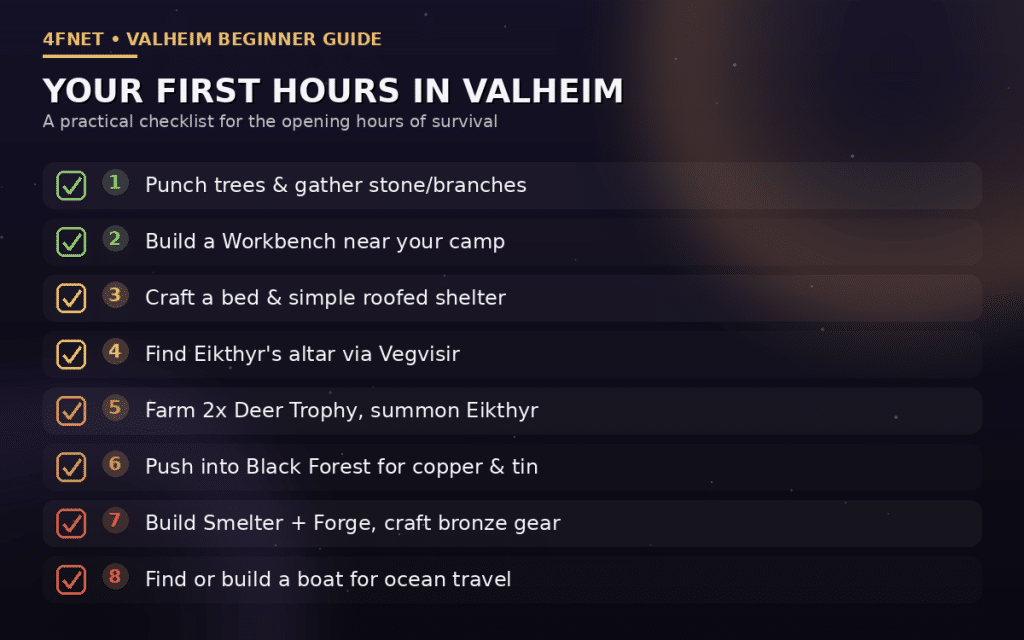
- Punch trees, pick up rocks and branches.s Your initial tools (stone axe and stone hammer) need basic wood and stone.
- Build a Workbench near your intended base; this unlocks basic building pieces and is necessary to craft your first tools.
- Find and kill Eikthyr, the first boss in Meadows. His altar is beside a Vegvisir runestone.
- Build a tiny base with walls, roof, bed, and campfire. Sleeping restores stamina/health regen and establishes your spawn point.
- Go to the Black Forest for crucial materials such as copper, tin, and wood varieties not found in the Meadows.
- After you’ve smelted together copper and tin in a Smelter, you can craft a Bronze Age toolset.
- Build or obtain a boat. The Meadows and Black Forest only bring you so far. To really move, you need to travel by ocean.
Section 3 — Beginner Tips
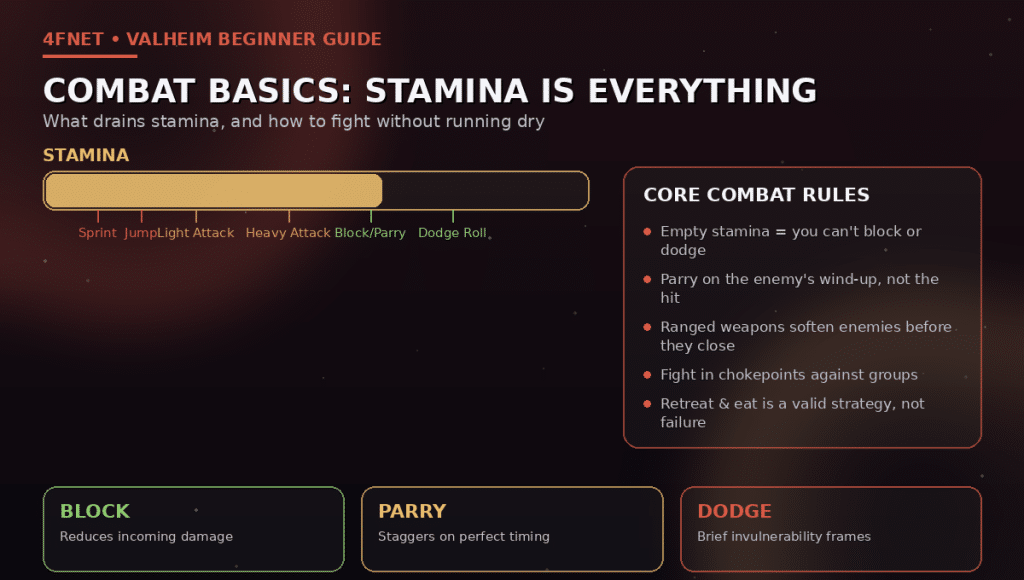
Tip #1: Build near a Black Forest border, not deep in the Meadows
Copper and tin run out rapidly.y OnlMeadows.ws A base at the edge of the Meadows/Black Forest allows you to access resources from both biomes without having to travel far.
Tip #2: Don’t ignore the Hoe
The Hoe helps you level and raise terrain, vital for building foundations and for making rampart walls against raids. It is typically skipped altogether by beginners and causes trouble with uneven building locations later.
Tip #3: Stamina governs almost everything
Stamina is used for running, swinging weapons, blocking, jumping, and swimming. New players have a tendency to strike wildly in combat and get shocked mid-fight from empty stamina — moderate your swings instead.
Tip #4: Three food slots, not one
You can have three meal buffs active at any one time, adding to your health and stamina pools. If you just eat one type of food,ood your effective HP going into a boss encounter is greatly hampered.
Tip #5: Portals skip most of your travel time
Once you have Fine Wood and Greydwarf Eyes, you can build portals to join bases immediately. Beginners tend to walk or sail the same long journeys over and over instead of investing early in a gateway hub.
Tip #6: Bonemass is a blunt-damage fight
Bonemass is immune to pierce and slash damage but weak to blunt damage—an Iron Mace (or equivalent blunt weapon) converts what appears like an unbeatable wall of health into a doable struggle.
Tip #7: Fire is a Swamp survival tool, not just a light source
Swamp adversaries (Draugr, Leeches, Blobs) are hazardous as a bunch. A campfire placed in a defensible location can clear or stall foes while you Regroup.
Tip #8: Don’t fully explore a biome before its boss
You don’t need to collect all the resources from a biome before facing its boss. Collect yourself some “boss-ready” gear, kill the boss, unlock some Forsaken Power, and then go back and complete looting the biome with better tools.
Tip #9: Use the Hammer’s building-piece author window if playing on a shared server
In the 1.0 version, we introduced an optional HUD toggle to show who constructed each piece, which is useful for big groups so you don’t mistakenly demolish a teammate’s build.
Tip #10: Watch for frozen water in the Deep North
The new biome features icy seas and lakes that might fracture beneath your feet. Ice crossings require just as much caution as Mistlands’ foggy terrain.
Section 4 — Combat Guide
Combat in Valheim is stamina-based and intentionally slower than typical action games.
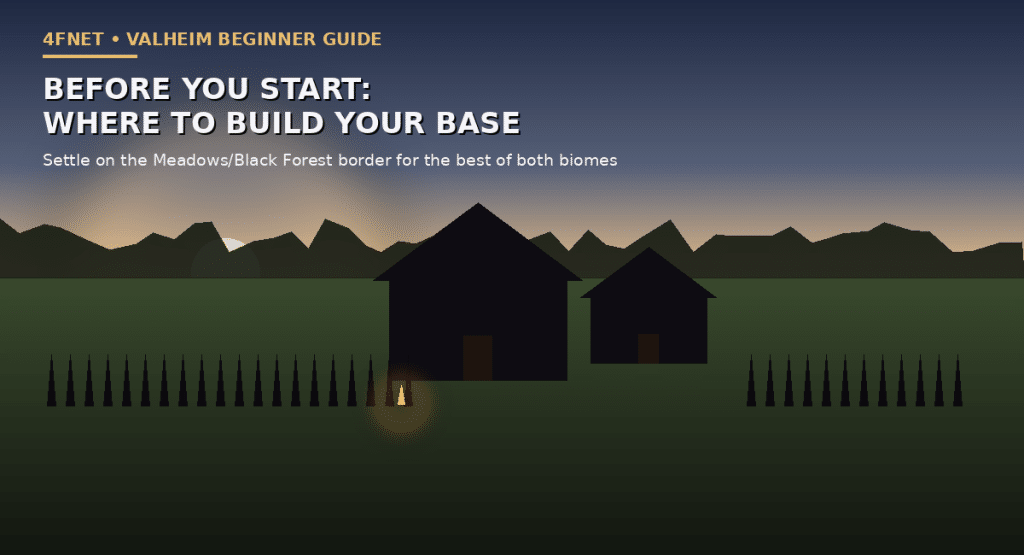
- Basic Attacks are based on the primary swing of your equipped weapon; most feature a secondary/heavy attack that costs more stamina, and either does more Damage or has a different arc of attack.
- Block mitigates damage taken based on your weapon or shield’s block power. Parrying (blocking right as an adversary attacks you) staggers most adversaries, allowing you to follow up with a free heavy blow.
- Dodge-rolling (with a shield or light enough carry weight) gives you a few frames of invulnerability, which is crucial when dealing with boss telegraphs like Eikthyr’s lightning stomp.
- Ranged weapons (bows, and later crossbows/staves) are important against deadly adversaries up close – Draugr archers, Fulings, and most bosses reward hybrid melee/ranged methods.
- Positioning is important as many adversaries (Greydwarfs, Fulings) swarm. Fighting in choke spots like entrances avoids becoming encircled.
- Food buffs (passive regen) heal you in the early game, not combat-usable potions/mead (healing meads can be crafted later). Eating and replenishing stamina in the middle of a combat is a regular, anticipated technique to retreat to, not a failed state.
Common battle mistakes: attacking out of stamina (you will be stunned), fighting several monsters out in the open instead of employing terrain, neglecting a boss’s special resistance (such as hitting Bonemass with a sword).
Section 5 — Progression Guide
Valheim progression is gated by biome bosses, not player levels. There’s no normal skill tree, but instead various skills (One-Handed Weapons, Bows, Running, Jumping, Blocking, etc.) level up passively as you use them, each making you better at that particular activity.
Confirmed boss order (1.0):
| # | Boss | Biome | Summon Item | Forsaken Power |
|---|---|---|---|---|
| 1 | Eikthyr | Meadows | 2× Deer Trophy | Reduced stamina drain (run/jump/swim) |
| 2 | The Elder | Black Forest | 3× Ancient Seed | Faster wood chopping |
| 3 | Bonemass | Swamp | 10× Withered Bone | Physical damage resistance |
| 4 | Moder | Mountain | 3× Dragon Egg | Tailwind for sailing |
| 5 | Yagluth | Plains | 5× Fuling Totem | Elemental damage resistance |
| 6 | The Queen | Mistlands | Sealbreaker (9 fragments) | Faster |
Each boss also gates crafting progression. Eikthyr’s death, for example, doesn’t directly unlock materials, but The Elder drops the Swamp Key needed to reach Sunken Crypts, while Bonemass drops the Wishbone used to identify hidden minerals. Newbies should follow this order, not racing ahead, as later biomes assume you have the previous biome’s gear tier.
Section 6 — Best Early-Game Choices
- Early weapon suggestion: A flint or bronze ax is your wood-gathering tool and your first genuine weapon. Good for novices who don’t want to split resources between many tools right away.
- Early armor worth using: Leather or Troll armor is a decent minimum before battling Eikthy; don’t wait for complete bronze armor to attempt your first boss.
- If you want to fight from a distance: A good alternative is to invest early in a simple bow and a stock of wood arrows, which will be useful against Draugr archers in the Swamp.
- Consider prioritizing: A Workbench and Smelter area near copper/tin deposits before you spend a lot of time on cosmetic building – functional crafting stations are more important than base aesthetics for the first several hours.
- Not worth it early: Fully explore Mistlands or Ashlands before you have Mountain-tier gear. The resource and enemy difficulty jump is steep and not beginner-friendly.
Section 7 — Beginner Mistakes to Avoid
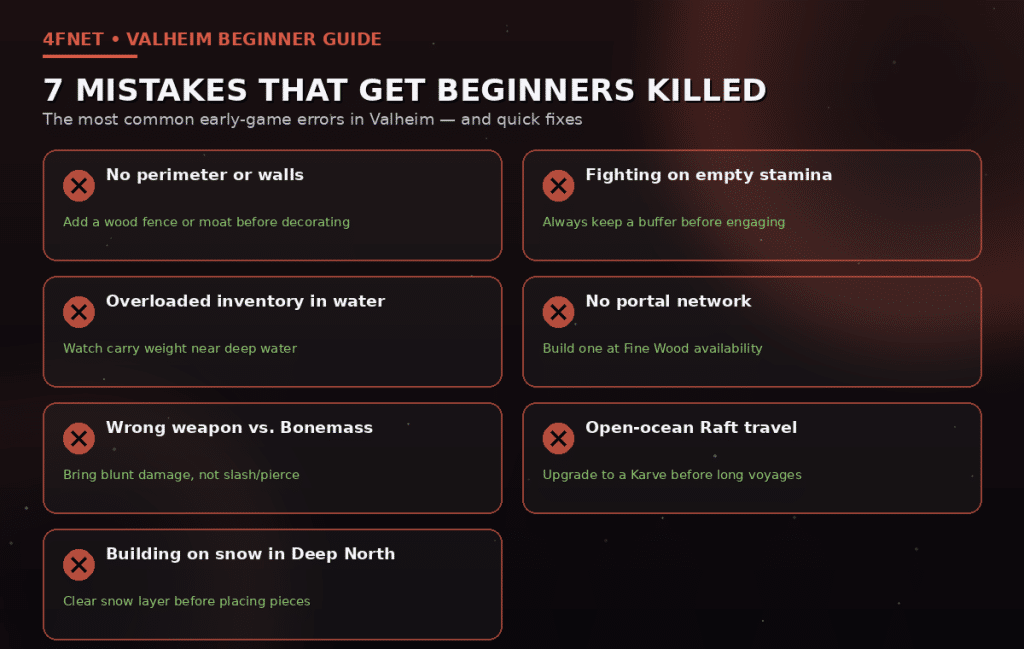
Mistake: Building a base with no wall or perimeter
New players typically create an open structure and get plundered by Greydwarfs or Boars with little defense. Early on, put in a basic wood border or moat.
Mistake: Ignoring stamina food buffs before boss fights
Fighting Eikthyr or The Elder at default health/stamina makes fights far harder than they need to be. Always eat before you start.
Mistake: Overloading your inventory and drowning
Excess weight slows swimming speed, and a heavy inventory in deep water is a frequent cause of early mortality. Watch your weight % around water.
Mistake: Skipping the portal network
Repeating the same long routes over and over again wastes hours. When you have Fine Wood, put up a portal hub in your main base.
Mistake: Fighting Bonemass with slashing weapons
As said before, Bonemass is resistant to pierce/slash. Bring a blunt weapon;n otherwise, the fight will take much longer than it should.
Mistake: Sailing into open ocean in a Raft
The basic Raft is fragile and slow, so upgrading to a Karve before you head out for significant ocean travel will save you from losing your cargo to Serpents or storms.
Mistake: Not clearing snow before building in the Deep North
The new biome features a coating of snow that must be removed before erecting structures, meaning newcomers unaware of this concept will find construction pieces refusing to place.
Section 8 — Early-Game Walkthrough (Spoiler-Light)
Hour 1-2: Collect basic wood, flint, and stone around your spawn point. Build a Workbench and a basic shelter with a bed; resting through the night skips the most deadly early hours and establishes your respawn point.
Hour 2-5: Look for a Vegvisir runestone in the Meadows (typically in burial chambers or given by the first one you find close to spawn) that points to Eikthyr’s altar. Farm 2 Deer Trophies, Summon and kill him.
Hour 5-10: Drive into the outskirts of the Black Forest for copper, tin, and core wood. Build a Smelter and Forge and start to create bronze tools and weapons. Locate the altar of the Elder and harvest three Ancient Seeds from nests guarded by Greydwarfs.
⚠️ Spoiler warning: Further exploration of the Black Forest takes you to Burial Chambers with Surtling cores inside (required for smelting). These dungeons are guarded; take a weapon upgrade before plunging in.
Hour 10+: After defeating The Elder, build or find a boat and begin looking for Swamp biomes. This is the next big step in progression, where you’ll find iron and Bonemass.
Section 9 — Resources, Loot & Money
Valheim doesn’t really have a currency system for most early trades – your main “money” is raw materials, and later on silver/gold coins used only with the trader Haldor.
- Important early resources: Wood, Stone, Flint, Copper, Tin, Core Wood, and Leather Scraps.
- What to save: Ancient Bark, Surtling Cores, anything to summon bosses with. These are gated and cannot be farmed en masse early on.
- What you can safely sell/use freely: Common wood and stone, after you have a reliable supply chain established.
- Inventory management: With the 1.0 update, players can contact Haldor for inventory upgrades – something to prioritize once you have some spare silver, as carry space is a persistent early bottleneck.
Section 10 — How to Get Better Faster
- Learn enemy tells, not only enemy kind. Most foes telegraph strong blows with a wind-up animation – dodging/rolling on the tell, not on reaction to the hit, is the main combat ability in Valheim.
- When in doubt, upgrade tools, not weapons. Having a better axe/pickaxe will speed up every resource gathering cycle that gates the rest of your progression.
- Don’t farm one biome too much. Get some “boss-ready” gear and go on. Later biomes tend to provide better copies of early materials anyway.
- Use the map ping/marker method to coordinate discoveries with your group rather than vocally re-exploring spots.
Section 11 — PC Settings & Performance
Valheim is not a very demanding game by modern standards, and Iron Gate has not released detailed official benchmark data for 1.0 performance. That said, there are certain settings worth knowing about:
- Draw Distance (new in 1.0): Sacrifices simulation range directly for performance – lower on inferior hardware.
- Resolution/Upscaling: Valheim allows conventional resolution scaling; if your PC has trouble with more demanding biomes, such as the Ashlands or the Deep North, it’s better to scale resolution down than to reduce shadow quality.
- Motion blur and shadows: Both can be turned down with little influence on visuals for gamers who care more about frame rate than realism.
- Controller vs. mouse/keyboard: Valheim supports both natively. For bows, decreasing aim sensitivity somewhat from default improves controller aiming, based on widespread community comments (this is user preference, not an official recommendation).
System Requirements Chart — technical data:
| Spec | Minimum | Recommended |
|---|---|---|
| OS | Windows 10 or later | Windows 10 or later |
| Processor | 2.6 GHz Quad Core or similar | i5 3GHz or Ryzen 5 3GHz |
| Memory | 8 GB RAM | 16 GB RAM |
| Graphics | GeForce GTX 950 or Radeon HD 7970 | GeForce GTX 1060 or Radeon RX 580 |
| DirectX | Version 11 | Version 11 |
| Storage | 1 GB available space | 1 GB available space |
Also, Check;
36 Fragments of Midnight
4×4 Evolution Racing Game
10. FAQ
What should I do first in Valheim?
Gather some wood and stone, make a Workbench, then a small shelter with a bed. Then go out and find the first boss, Eikthyr. Kill him.
What is the best beginner build in Valheim?
No classes here – everyone may use any type of weapon. Basic leather or troll armor with a bronze axe/sword combo is a good, versatile early setup.
What are the best early upgrades in Valheim?
The most valuable early upgrades would be a Workbench and Smelter near the copper/tin mines, and then a gateway hub once you have Fine Wood.
What mistakes should beginners avoid in Valheim?
Typical rookie errors include failing to build a perimeter, not taking food buffs before bosses, filling your inventory with items next to water, and battling Bonemass with the wrong weapon type.
Is Valheim difficult for new players?
Stamina management and biome-gated progression come with a learning curve, but nothing in the early game is about precision reflexes – timing and preparation are more important than skill execution.
How does progression work in Valheim?
You battle the biome bosses in succession ( Eikthyr, The Elder, Bonemass, Moder, Yagluth, The Queen, Fader, and now Kall Fimbulbringer in Deep North ), and each one unlocks a new tier of crafting and a new location.
What should I spend my resources on first?
In the first few hours, don’t bother creating anything fancy; just get a Workbench, Smelter, basic bronze tools, and a portal hub.
Can I change my build later?
Yes, there are no set classes, so you can change weapon types and skills at any time you choose. The only thing that takes time to rebuild is your passive skill levels (which are boosted by usage).
What are the best settings for Valheim on PC?
The best thing to do for inferior hardware players is to turn down Draw Distance (added in 1.0) and motion blur. No official benchmark statistics have been provided.
How long does the early game take?
How long this takes will depend on your playstyle and group size, but it normally takes a few hours to get there and kill Eikthyr, then many more to push into the Black Forest and into The Elder.
Is Valheim 1.0 the same game as Early Access?
The core survival/building loop remains the same; 1.0 adds the Deep North biome, a new boss, new weapons/armor, and new platforms (PS5, Switch 2) with crossplay.
Do I need to start a new world for Valheim 1.0?
Not quite. Existing worlds and characters will still work, but any new Deep North terrain will only be found in unknown sections of the globe. So Iron Gate encourages you to start a new world for the full experience.